Another Tire-Related Development

Good morning.

Recently I conducted a search on why, after long-term storage of my car about 5 months, one of my tires pressure was 4psi lower than the others. I had set them all a little high, 40psi for storage.
Upon returning, three of them had dropped to 35psi - the weather was colder - but one was at 32.

Google results included the obvious - a tire puncture, but I think that tire would have been flat after 5 months storage. They also suggested checking the vaves and the stem cores.

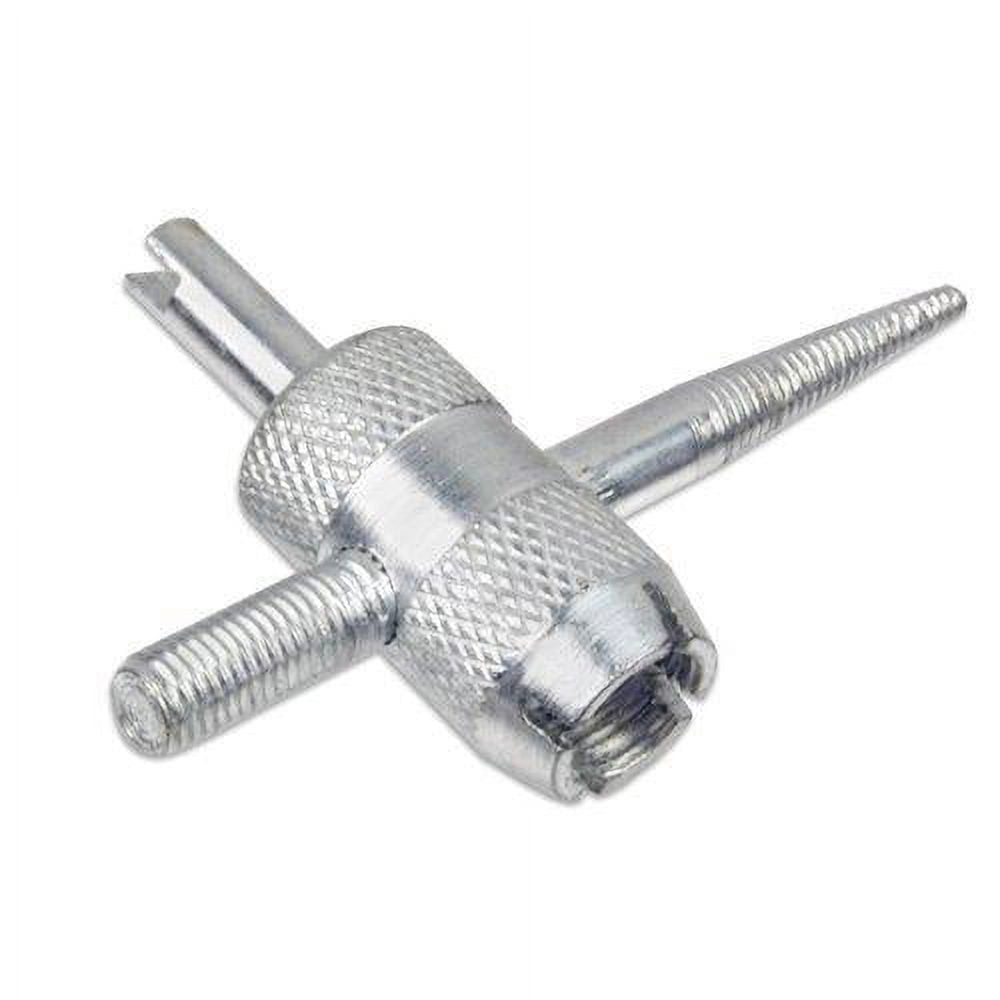
So I purchased a 4-in-one tire tool, and using the valve stem core side I checked the cores.

4-way-Tire-Valve-Stem-Core-Tool-4-Pack_59bdbdc4-0e21-4ee6-bfcb-07196dc07f6f.97ba7cb72d9b708dcd9f107b1fac0f04.jpeg (1000×1000)

I turned them initially counter-clockwise just a hair, and they started hissing air. I mean, they were loose, it was no effort for me to turn either direction. Is it possible for them to loosen over time, due to temp. swings, etc.?

So I tightened them all by feel until they felt reasonably tight without hamfisting them. That was about the best $4 I spent spent in a long time!

Next morning, I set all pressures with a digital gauge, ‘33.0’ psi

We’ll see in two weeks, if they’re all exacty the same pressure (33.7 or 34.1 or whatever, with the same gauge) by then, then my efforts fixed the inconsistency.

I hope this information is helpful to even one reader, and nobody take offense to it.

I have found and or seen many Schrader valves loose enough to cause a leak rather it be fast or slow over the years, I would either just replace it or tighten it up and go on about my business, never put much thought into it, but it does happen, the valve stem and Schrader valve is one of the 1st places I spray checking for leaks if not dunking the tire in water…

1 Like

Normal people are going to just inflate each tire to the proper weight and go on about the lives and find something else to obsese over.

1 Like

The Schraeder valve seal is a polymer (a plastic). Polymers creep a bit when loaded… they deform and stay deformed. That explains why they were a touch loose and why one tire lost a bit more air than the others…that one seal crept a bit more and let a few more psi out.

And car life goes on.

3 Likes

BTW, you can get either a new or used (old one w/big end broken off during removal) valve stem and screw your 4 way stem tool and now you have a handle for when you are checking/tightening (or removing) your/anyone’s Schrader valve(s), much easier to use…Odds are you will never use the other 3 parts of the tool…

3 Likes

Yep, we also added a used valve stem at the gas station, and I also only used the Schraeder core remover/installer.

1 Like

I call the valve stem internals a core. But that’s me.

The correct, technical name for a valve stem core is a Schrader valve core. It is also widely referred to as a standard valve core, tire valve core, or simply a core.

So any of the above is adequate…Now worries either way… lol

1 Like

I’m (as usual) confused.

They do make a stem-core tool solo, that looks like a screwdriver in form, but has the stem core interface at the end, not a flat or Philips.

Is that what you’re referring to?

Yes

No

using the female thread end of the tool and screw a old valve stem up in it with the Schrader core tool part opposite to the female threads to it use like a screw driver…

old valve stem goes in the red area…

1 Like

This is the tool Chris is referring to:

When a kid, had these on my bicycle stems since flats were common.

I still don’t get the purpose of doing so.

Sorry, you’re wasting your time, I’ll never get it!

Now I understand the four parts after watching a short video. One thing not covered though if replacing a valve stem, you can screw the stem to the tool and you can pull it in place. Yeah and don’t waste you money on the harbor freight tire changer. A couple tire irons do the job on small tires and take the big ones to a store.

Just ease of use, like using a very stubby screw driver vs using a standard screw driver…

I have both the 4way and the one in Purebred’s post (back and red handle) and when every I need one, I normally just grab the 4way one (one a stem) out of habit… If I felt better I would go down to the garage and take a pic of them…

Tires can lose air pressure over 5-months for many reasons and none are necessarily the valve stem…

Car tires naturally lose air pressure over time due to a process called permeation, where air molecules slowly escape through the microscopic pores of the rubber. Even a tire in perfect condition typically loses about 1 to 2 PSI (pounds per square inch) every month. That alone could account for the lost tie pressure…

It was November 5-months ago and depending on the temperature then and the temperature now that could also exasperate the difference, making it more or even less…

(If it was really cold last November and really warm today at your location, you might be asking how did the tire pressure increase over the last 5-months?) :wink:

Slow Leaks can be caused by minor punctures (like a small nail), or a poor seal between the tire and the rim (bead leak) caused by corrosion on the rim or a bent wheel (from hitting a pothole) can break the airtight seal, leading to gradual air loss, Yeah and even a faulty valve stem

You did not mention the age of your tires and as they age, the rubber becomes more porous and brittle, which can increase the rate of air loss.

1 Like

A tire may also lose air due to a porous alloy wheel.

Tester

2 Likes

I set the tires to 40psi for storage fully expecting them all to have a much lower pressure by early March. I do undestand the reasons why this happens, else I would not use my handle.

3 of them, again, precisely 35psi.

The 4th: 31-32psi.

That should not happen, unless there is a leak somewhere - the tire itself, or, where tire meets rim, or, the vave area or stem itself.

The tires were purchased and installed in October of 2023, and are probably at most 3 years old (April 2023 to present), maybe 3 1/2. I will check the date codes tomorrow.

Nothing new here

@ChrisTheTireWhisperer is complaining about a NON-problem

as usual

3 Likes

Regarding a difference in tire pressure over time for tires that otherwise ought to lose the same pressure:

What has already been mentioned: Differences in valve core tightness, Differences in alloy wheel porosity

And what has not been mentioned: Differences in the tire to wheel seal. The company I worked for set up a wheel and tire on its side in a pool of water and floated a plastic sheet on surface of the water.. I don’t remember the timeframe, but it was clear that there was a ring of bubbles above the mating surface of the tire/wheel. There were also bubbles above the valve. They couldn’t determine if it was the core leaking or the valve/wheel interface. Yes, the tire itself leaked, but the bubbles were quite scattered.

3 Likes

Hi there Capri, appreciate that!

Yeah I could do a soapy spray water bottle test, as I don’t presently have a tub big enough to dunk in.