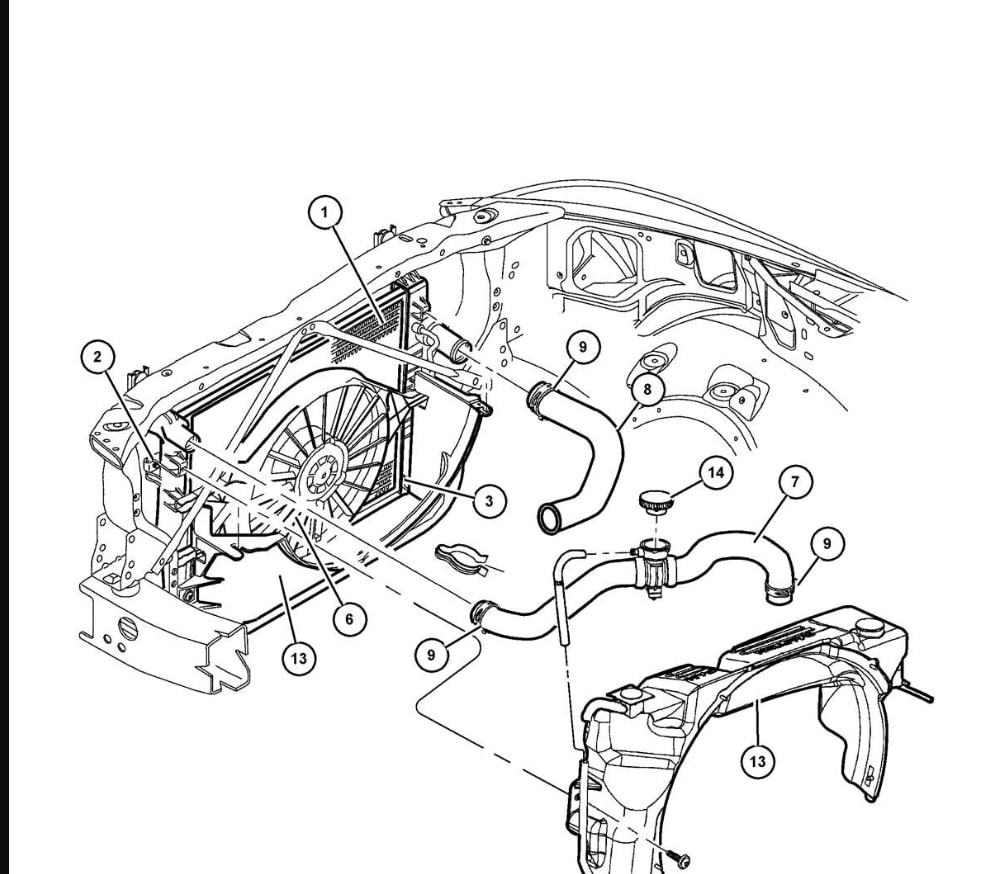
Relocting the cooling system cap allows clearance for a lower hood or for a taller radiator.
The engine below has no "radiator cap but it has 3 fill locations.

Who is responsible for the unachievable fuel economy standards?
PEBSAS (based on a funny IT-based acronym)
Chris:
Car manufacturers have been using a remote coolant surge tank containing the pressure cap going back to the 60s. Nevada replied with one of the main reasons.
Reading a post calling it boneheaded tells me a lot.
I am fully aware of that. All of the cars I’ve driven have had the overflow tank, and had caps on both that tank and on the radiator.
What I was referring to as boneheaded was the idea of removing the cap from the radiator. Apologies if I was in anyway vague.
I agree with @JoeMario . . . you @ChrisTheTireWhisperer need to grasp how automotive things work before railing against everything
As I see it, you’re in no position to do so at this time
The cooling system needs a pressure relief and fill port somewhere. It doesn’t matter where it is.
My car has the fuel filler on the right side, my wife’s car has it on the left side, my 77 Olds had it in the middle. Either way, the gas tank got filled.
I’m sorry if I haven’t yet been clear:
On every car I’ve ever owned/driven, there has been a cap on both the pressure relief container and on the radiator itself.
The only reason I could see eliminating the cap from the radiator is one less part - to save money.
Any other reasons?
One (or several) fewer part(s) also makes the system simpler and more reliable, and in this case less prone to misuse. Say you have a radiator with a pressure cap, and an overflow hose connected to a reservoir, also with a cap. Let’s change that to a radiator and a surge tank/degas bottle with just one cap. No more high pressure/low pressure, just one system with one cap. No overflow reservoir for DIY Joe to constantly overfill and leak coolant, no question about fill this and then that…
Sure there are examples like Nevada posted that have multiple caps, but who owns a Lexus and DIY’s their car maintenance?
No one ever told me, and I always knew that I was to add engine coolant/antifreeze only via the overflow reservoir. Once in a while, when the engine was cold, I’d remove the radiator cap and shine a light inside to check for buildups/ hard deposits, etc. But I never poured anything in there.
I would, if I drove one. Check tires, check fluid level and condition, check air filters, top off the windshield washer reservoir. Even pull the PCV valve and give a shake. It’s just something we all did, and was expected, back in “my day”..!
If that part also serves as the thermostat housing (or something else that is already needed there), then yes, it could reduce costs to do it that way. Simplifies the radiator and already casting/machining a housing so not much more expensive to add the cap feature to it.
I think it is more of, it is the highest place due to the low (profile) mounted radiator (rad) for air to bleed out of the cooling system, much better than a rad mounted rad cap with a bleeder screw where the rad cap currently is, makes for burping the coolant system easier…
Whatca think about a rad cap in the middle of the rad hose…
Ooh yeah I had forgotten about those.