- Listen
- Our Show
- Car Info
- Buying
- Owner Reviews
- Tom and Ray's Reviews
- Research a Car
- Find a new or used car
- Cars We Hate the Most
- Secret Tricks of Car Salesmen
- Hybrid Vehicles
- Calculator
- New Car Incentives
- More…
- Owning
- Post a Review of Your Car
- Tom and Ray Explain Maintenance
- Check Safety Recalls
- Want To Do It Yourself?
- How To Keep Your Car Running Forever
- Premium vs. Regular
- Change a Flat
- Car Cleaning Tips from a Pro
- Official Car Talk Guide to Jump-Starting Your Car
- Guide to Better Fuel Economy
- More…
- Cars.com Content
- Mechanics Files
- Blogs
- Community
- Fun Stuff
- Store
- Contact
Comments
And not only is the last state completely determined by the stated restrictions, the last *seven* states will always be the same, and there is only one order you can take them in.
- Spam
- Abuse
- Troll
Off Topic Disagree Agree Like- Spam
- Abuse
- Troll
Off Topic Disagree Agree Like- Spam
- Abuse
- Troll
Off Topic Disagree Agree LikeIf you go to Massachusetts first, you then have to hit either New York, Rhode Island or Connecticut next. If you do New York, you're stuck because you've cut off Vermont on one side from R.I. and Conn. on the other, so stay out of New York just yet. If you go from Mass. to Conn., same problem: you have to either miss Vermont or R.I. after you've taken care of New York. And if you do Rhode Island now, your only following choice is Conn. which will again lock you out of Vermont after you then move on to the only option for the step after. So going from New Hampshire to Massachusetts is out. You have to do Vermont after New Hampshire.
So after Vermont, you have the same problem if you next try to do New York: three New England states and the rest of the country, and you're unable to get to one group to the other. Which means after Vermont must come Massachusetts. If you go to Connecticut after that, Rhode Island is cut off from the remaining states, so that doesn't work; you have to do Rhode Island, *then* Connecticut. And at this point the only next step is New York.
(Notice that New York and New Hampshire are the only states that make the map of the Lower 48 fall into two unconnected pieces if you remove them. That makes them special in a problem like this.)
So, to recap, first seven states *must* be Maine > New Hampshire > Vermont > Massachusetts > Rhode Island > Connecticut > New York, and they must be in that order. After that you do Pennsylvania and New Jersey, and it doesn't really matter which one you do first, or if you do them one after the other right now. Other places along the way where you're going to have your route tightly constrained for you are the Washington/Oregon/Idaho set and a couple of overlapping triplets (the Carolinas and Georgia, and Georgia/Alabama/Florida).
- Spam
- Abuse
- Troll
Off Topic Disagree Agree LikeYou certainly put a lot of thought into this puzzler. Yes, the salesman must either start or finish in Maine if he is to visit each state once and only once. And New York state is unique in that it forms a barrier between the New England states and the remaining states — once past NY, going in either direction, the salesman can never return to the section he just left, be it New England or the lower states.
Some interesting solutions to 48-state problems from the Computer Sciences department at Carnegie-Mellon are given below:
Interesting Map Problems — CS@CMU
Hamitonian circuits/paths are similar mathematically to map-coloring problems, so that is why the two topics are discussed together in the above paper.
Hamiltonian circuits/paths (it is a circuit if the salesman returns to his starting point; it is a path if he does not) are extremely difficult to find, or even to show that one exists in a given problem. There is no algorithm that leads directly to a solution, or even one that tells if a solution exists. There are ad hoc heuristic approaches for some problems, however.
Hamitonian circuits/paths and map-coloring form a branch of mathematics called Graph Theory. The theory has numerous applications in the hard sciences, electrical engineering (designing complex circuit boards, for example), the biological sciences, and businesses (delivery truck routing comes to mind).
A brief, non-mathematical primer on Graph Theory is:
Combinatorics: The Fine Art of Counting
Week 8 Lecture Notes: Graph Theory — MIT
Below is a problem one may want to try. It has historical significance (google "Hamilton's icosian" if you are curious). Hamilton developed it into a child's board game with a circular mahogany board, ivory pegs to insert into the nodes (holes) and twine to string around the pegs to mark the pathways. Hamilton sold all rights to the game for £25 in the 1850's. Today an original game is worth about $500,000. BTW, the Irish-born Hamilton, 1805-1865, may have been the most brilliant mathematician of the 19th century.
The figure itself is just the projection of a Dodecahedron upon a plane.
Question #1: Starting at any node ("dot") can one progress along the lines around the figure through all the nodes without passing through the same node twice?
If so, then one has traced out a Hamiltonian path.
Question #2: Can one do the same as above but return to the same node from which one started?
If so, then one has traced out a Hamitonian circuit.
I won't say beforehand whether any path or circuit exists.
Have a go!
- Spam
- Abuse
- Troll
Off Topic Disagree Agree LikeStealing from Jim Kelly in Enter the Dragon, "I'll be too busy looking good."
Seriously, most people don't have the map of the U.S. memorized. A little pomposity goes a long way. Less goes even farther.
There is no unique solution if Maine is the starting state.
- Spam
- Abuse
- Troll
Off Topic Disagree Agree Like- Spam
- Abuse
- Troll
Off Topic Disagree Agree LikeAnd yes, I've put a lot of thought into it, but years before it became a puzzler. I wanted to work out an actual route and see if it was feasible. It got a little hinky when one of the routes wanted me to go directly from Oklahoma into New Mexico; there's a short section of border there but not a lot of major roads cross it, so while it's actually doable it's not in any sense practical.
And then there's the "New Madrid Bend", where the states of Kentucky, Tennessee and Missouri meet, not at a single point but at three different points a few miles apart.
- Spam
- Abuse
- Troll
Off Topic Disagree Agree Like- Spam
- Abuse
- Troll
Off Topic Disagree Agree Like- Spam
- Abuse
- Troll
Off Topic Disagree Agree LikeThere's additional discussion of similar routes through even larger sets of points, including one that visits hundreds of thousands of points.
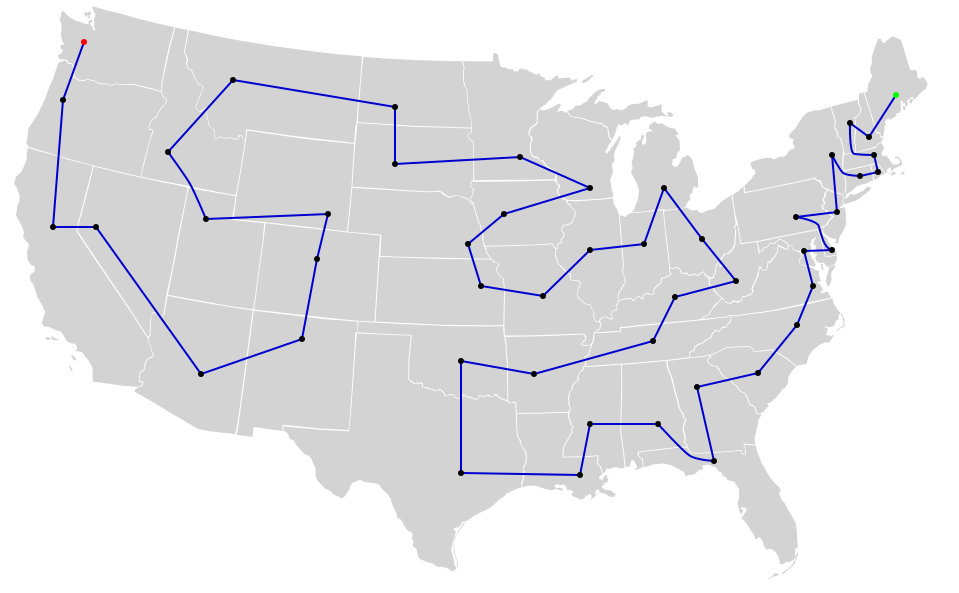
The shortest route going through the 48 state capitals is shown here:
Note that this cannot be the route in the Puzzler because an additional condition there was that you had to start in Delaware.
- Spam
- Abuse
- Troll
Off Topic Disagree Agree LikeInteresting Map Problems — CS@CMU
- Spam
- Abuse
- Troll
Off Topic Disagree Agree Like- Spam
- Abuse
- Troll
Off Topic Disagree Agree Like- Spam
- Abuse
- Troll
Off Topic Disagree Agree LikeGuess you need to update your browser, because as we know, that's the solution to everything on the internet. :)
- Spam
- Abuse
- Troll
Off Topic Disagree Agree LikeYou're not going to get many rabbits with arrows like that.
- Spam
- Abuse
- Troll
Off Topic Disagree Agree Like